
Years ago, I came-up with ways to create customized Heroes. After to retooling, I came-up with this (more or less). So here is what it looks like:
Base Body and Mind Points: Distribute 10 points between the two scores. They must be between 2-8.
Base Attack Die: 1
Base Defense Die: 2
Base Movement Points: 8
Base Luck Points: 0
The player may allocate 1 (or more - see below) point, to buy the following:
1 point per extra Body Point (up to 8).
1 point per extra Mind Point (up to 8).
1 point per extra die of Attack (up to 3).
1 point per extra die of Defense (up to 3).
1 point per 2 extra Movement Points (up to 12).
1 point per Luck Point (up to 3). (these points are used to make re-rolls or "draw again" results)
1 (or more) point per skill (up to 3).
Here are some samples of skills:
Trap Mastery - (as Dwarf)
Basic Spellcasting - May cast one spell element.
Assassin - Count as having an unlimited supply of Daggers, for the sake of throwing.
Fleet-Footed - Can cross difficult squares, as if they are empty squires.
[monster]-Slayer - re-roll one Attack Dice against a chosen type of Monster (e.g. Goblin-Slayer).
Wealth - Gain a 100 gold coin stipend after each Quest (or 500, with 2 points).
Hit-and-Run - May move, stop to attack, then continue to move, if any MPs are left.
Sneaky - May enter a room unnoticed by monsters on a 5 or 6 (if alone, the monsters count as inactive, until another Hero 'sees' it)
Foresight - Can detect monsters (and what types) on the other-side of a closed door, on a 5 or 6.
Divine Hand - Once per game (per point), the Hero can recover 1-6 Body Points, on himself, or an adjacent Hero.
Advanced Spellcasting (counts as 2 skills) - May cast three spell elements.
Divine Aura (counts as 2 skills) - Undead and Demons cannot be adjacent to the hero, on a 5 er 6.
Fast (counts as 2 skills) - gain an extra action for the turn (up to 2 actions).
Players may add to the the above, by taking any of the following handicaps:
1 extra point, by loosing one Body Point (as low as 2).
1 extra point, by loosing one Mind Point (as low as 2).
1 extra point, by loosing two Movement Points (as low as 4).
1 (or more) extra point, by taking a disability (up to 3).
Here are some samples of disabilities:
Untrained Fighter - Limited to weapons and armor usable by the Wizard (namely the Staff and Dagger).
Berserker - If attacking a monster, with Hero also adjacent, the Berserker attacks the Hero on a 5 or 6.
Proud Fighter - Rejects all spells and shooting weapons (like the Bow), save for throwing weapons (like Daggers, Axes, and Spears)
Fear of [monster] - Cannot move adjacent to a chosen type of Monster, on a roll of 5 or 6.
Outstanding Debt - Hero loose the ability to shop at the end of the game on a 5 or 6, until the Hero pays a 2,000 gold coin debt.
Outcast (counts as 2) - Can never go shopping - can still barter with the other Heroes, to their discrimination.
Inhuman Body (counts as 2) - Immune to healing spells and potions (can still heal normally between Quests).
Pacifist (counts as 2) - Can only attack Undead, Demons, and Animated constructs, plus your are limited to using blunt weapons and non-offensive spells.
Insane (counts as 2) - Roll one Combat Die per Mind Point on the start of the Hero's turn. Failure to roll a White Shield means the Hero is under the control of the Evil Wizard Player, for that turn.
Skills (and disabilities) maybe bought (or bought-off) for 2,000 gold coins, per point of value. If you are running a story-driven adventure that emphasis character development, then the cost can be lowered by half or so, if the desired skill (or lost disability) fits into the plot or has a good back-story. If you what more variety, you can add 3 points, instead of 1, but this would make the Heroes a little more powerful. Adding more skills and disabilities is always good (although, too many special rules could quickly bog-down the game, like an epic-level v3.5 D&D game). It is best to create the Heroes for the players to choose from, as players tend to abuse the system with min/maxing. Although, it is always good to be mindful of the players' options and ideas with this system. The lack of a "cleave" skill (or "death-blow'", in WHQ) is do to it being standard in my games (that is, a successful attack with surplus damage can be carried over to the next adjacent opponent).
Here are some examples:
Barbarian
Body Points: 8
Mind Points: 2
Attack Die: 3 (Broadsword)
Defense Die: 2
Movement Points: 8
Luck Points: 0
Special Skills:
- none
Dwarf
Body Points: 7
Mind Points: 3
Attack Die: 2 (Hand Axe)
Defense Die: 2
Movement Points: 8
Luck Points: 0
Special Skills:
- Trap Mastery
Elf
Body Points: 6
Mind Points: 4
Attack Die: 2 (Shortsword)
Defense Die: 2
Movement Points: 8
Luck Points: 0
Special Skills:
- Spells (one set)
Wizard
Body Points: 4
Mind Points: 6
Attack Die: 1 (Dagger)
Defense Die: 2
Movement Points: 8
Luck Points: 0
Special Skills:
- Spells (3 sets)
- Untrained Fighter
Thief
Body Points: 4
Mind Points: 5
Attack Die: 1 (Dagger)
Defense Die: 2
Movement Points: 10
Luck Points: 0
Special Skills:
- Assassin
- Trap Mastery
- Sneaky
- Foresight
- Untrained Fighter
- Outcast
Cleric
Body Points: 6
Mind Points: 4
Attack Die: 1 (Staff)
Defense Die: 2
Movement Points: 8
Luck Points: 0
Special Skills:
- Divine Hand
- Divine Aura
- Pacifist
Knight
Body Points: 7
Mind Points: 2
Attack Die: 3 (Broadsword)
Defense Die: 3 (Chainmail)
Movement Points: 8
Luck Points: 0
Special Skills:
- Proud Fighter
Paladin
Body Points: 7
Mind Points: 2
Attack Die: 3 (Broadsword)
Defense Die: 2
Movement Points: 8
Luck Points: 0
Special Skills:
- Divine Hand
- Proud Fighter
Ranger
Body Points: 6
Mind Points: 2
Attack Die: 2 (Short Bow)
Defense Die: 2
Movement Points: 8
Luck Points: 0
Special Skills:
- Fleet-Footed
- Hit-and-Run
- Foresight
- Sneaky
- Outcast
Halfling
Body Points: 5
Mind Points: 5
Attack Die: 1 (Dagger)
Defense Die: 2
Movement Points: 6
Luck Points: 1
Special Skills:
- Fleet-Footed
- Sneaky
I have been working on this system for a Flash Gorden/Star Wars-styled HQ game. This would require more skills to help round-out the archetypes for the science-fantasy setting.
-
- Advertisement
Make a small donation to Ye Olde Inn!
Every cent received goes toward Ye Olde Inn's maintenance and allows us to continue providing the best resources for HeroQuest and Fantasy Gaming fans.
Customized Heroes with Skills and Disabilities
8 posts
• Page 1 of 1
Customized Heroes with Skills and Disabilities
 by Malcadon » January 6th, 2013, 7:57 am
Last edited by Malcadon on September 8th, 2013, 4:26 pm, edited 1 time in total.
Rewards:


-

Malcadon
Necromancer
- Posts: 320
- Images: 4
- Joined: March 9th, 2012, 7:47 pm
- Forum Language: English (United States)
- Hero:

- Evil Sorcerer: Zargon
- Usergroups:


Advertisement
Make a small donation to Ye Olde Inn!
Every cent received goes toward Ye Olde Inn's maintenance and allows us to continue providing the best resources for HeroQuest and Fantasy Gaming fans.
Re: Customized Heroes with Skills and Disabilities
by knightkrawler » January 6th, 2013, 10:40 am
We've discussed that on OldScratch.
I have a similar system to calculate stats and skills, much more complicated.
Which makes yours, well, better...
I have a similar system to calculate stats and skills, much more complicated.
Which makes yours, well, better...
HQ - Heroes & Villains (Dropbox-download link) https://www.dropbox.com/sh/jgj0kzsys9w38oh/AAA_VEHx6vMv4HKRX7IiOWTFa?dl=0
Feedback http://forum.yeoldeinn.com/viewtopic.php?f=38&t=3560
Gallery http://forum.yeoldeinn.com/viewtopic.php?f=56&t=1972&hilit=knightkrawler+gallery&start=200
____________________________________________________________________________________________________________
I've found a way of paying off old debts:
Always make more promises than you can break.
Feedback http://forum.yeoldeinn.com/viewtopic.php?f=38&t=3560
Gallery http://forum.yeoldeinn.com/viewtopic.php?f=56&t=1972&hilit=knightkrawler+gallery&start=200
____________________________________________________________________________________________________________
I've found a way of paying off old debts:
Always make more promises than you can break.
Rewards:


-

Cheese Baron
knightkrawler
The Furry Blue Derailer
Witch Lord
- Posts: 5825
- Images: 27
- Joined: May 25th, 2012, 2:26 pm
- Location: Regensburg, Germany
- Forum Language: English (United States)
- Hero:

- Evil Sorcerer: Morcar
- Usergroups:

Re: Customized Heroes with Skills and Disabilities
by Malcadon » January 6th, 2013, 11:16 am
Yeah, I'm just spreading my house-rules around. This one has been altered a bit.
By they way, I really like your Kurt Wagner of Mars icon! Nightcrawler is my favorite X-Man, and I'm a big fan of ERB's Barsoom setting.
By they way, I really like your Kurt Wagner of Mars icon! Nightcrawler is my favorite X-Man, and I'm a big fan of ERB's Barsoom setting.
Rewards:
-
Malcadon
Necromancer- Posts: 320
- Images: 4
- Joined: March 9th, 2012, 7:47 pm
- Forum Language: English (United States)
- Hero:
- Evil Sorcerer: Zargon
- Usergroups:
Re: Customized Heroes with Skills and Disabilities
by knightkrawler » January 6th, 2013, 11:33 am
Ah, yes...
The Cross-Time Caper. Some of comic books' best issues ever...

That was Nightcrawler's spotlight issue, which you think of by "Kurt Wagner of Mars".
I mean, look at this cover, N.'s babe...
My avatar, however, is from a time when Nightcrawler was going really badass, courtesy of Warren Ellis, the world's best comic book writer:
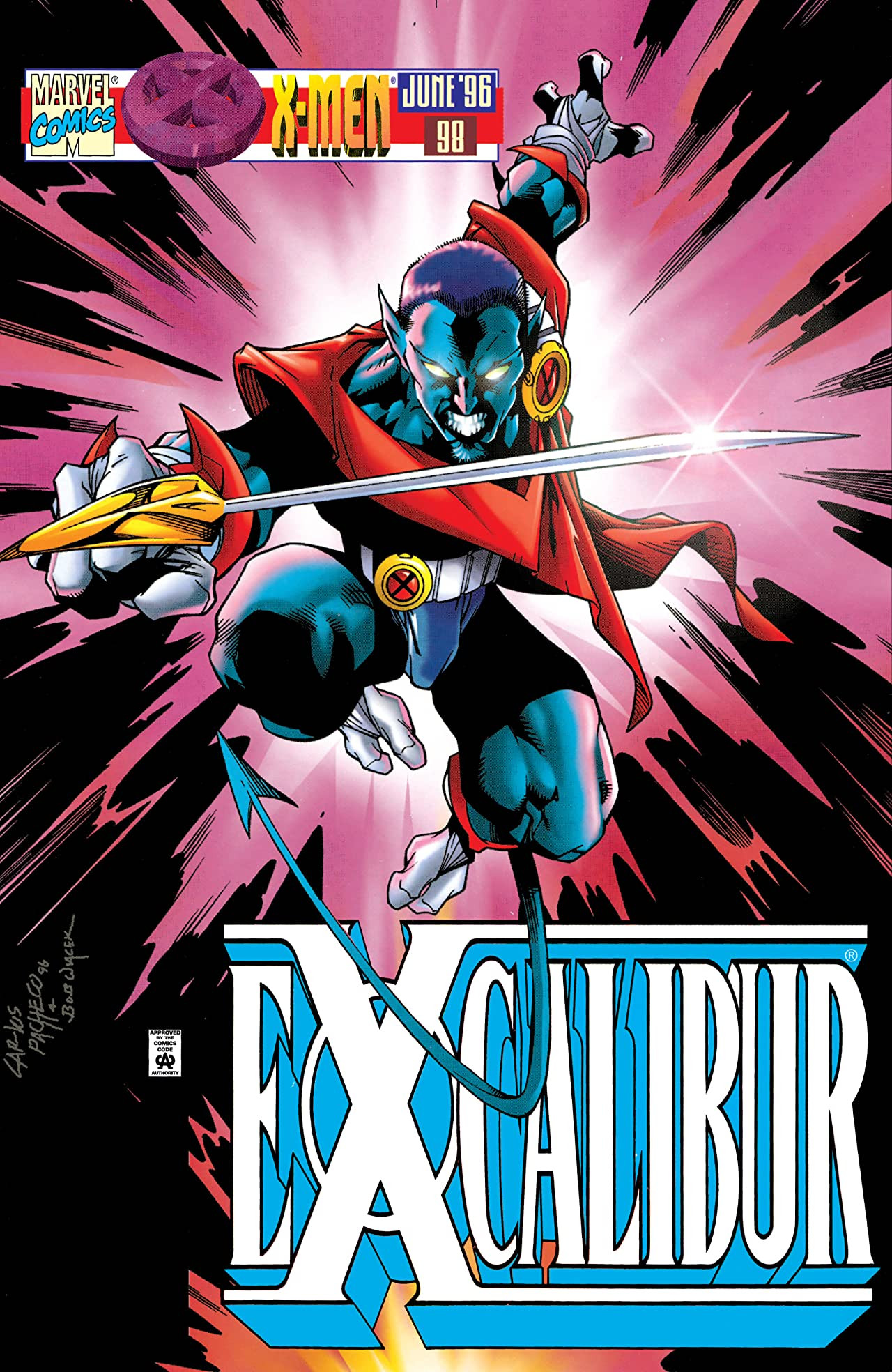
Of course, Ellis paid tribute to Claremont/Davis' rendition of Nightcrawler.
He's of course my favourite comic book character...
The Cross-Time Caper. Some of comic books' best issues ever...
That was Nightcrawler's spotlight issue, which you think of by "Kurt Wagner of Mars".
I mean, look at this cover, N.'s babe...
My avatar, however, is from a time when Nightcrawler was going really badass, courtesy of Warren Ellis, the world's best comic book writer:
Of course, Ellis paid tribute to Claremont/Davis' rendition of Nightcrawler.
He's of course my favourite comic book character...
HQ - Heroes & Villains (Dropbox-download link) https://www.dropbox.com/sh/jgj0kzsys9w38oh/AAA_VEHx6vMv4HKRX7IiOWTFa?dl=0
Feedback http://forum.yeoldeinn.com/viewtopic.php?f=38&t=3560
Gallery http://forum.yeoldeinn.com/viewtopic.php?f=56&t=1972&hilit=knightkrawler+gallery&start=200
____________________________________________________________________________________________________________
I've found a way of paying off old debts:
Always make more promises than you can break.
Feedback http://forum.yeoldeinn.com/viewtopic.php?f=38&t=3560
Gallery http://forum.yeoldeinn.com/viewtopic.php?f=56&t=1972&hilit=knightkrawler+gallery&start=200
____________________________________________________________________________________________________________
I've found a way of paying off old debts:
Always make more promises than you can break.
Rewards:
-
Cheese Baron
knightkrawler
The Furry Blue Derailer
Witch Lord- Posts: 5825
- Images: 27
- Joined: May 25th, 2012, 2:26 pm
- Location: Regensburg, Germany
- Forum Language: English (United States)
- Hero:
- Evil Sorcerer: Morcar
- Usergroups:
Re: Customized Heroes with Skills and Disabilities
by Sjeng » January 6th, 2013, 11:41 am
Malcadon wrote:By they way, I really like your Kurt Wagner of Mars icon! Nightcrawler is my favorite X-Man, and I'm a big fan of ERB's Barsoom setting.
Wait, what? X-Men and John Carter universes were mixed? Nightcrawler on Barsoom? Ánd he's carrying Excalibur (which if I recall correctly was not a cutlass)? I am SO confused by all those crossovers xD
Check out my YouTube channel Boardgame Heaven, and drop me a sub please!
Rewards:


-

Official Spokesman
Sjeng
Ye Olde Orcish Bard
Wizard
- Posts: 4536
- Images: 92
- Joined: July 26th, 2011, 9:58 am
- Location: The Netherlands
- Forum Language: Nederlands
- Hero:
- Evil Sorcerer: Morcar
- Usergroups:


Re: Customized Heroes with Skills and Disabilities
by knightkrawler » January 6th, 2013, 12:02 pm
We're getting very OldScratchy here, what with all the digressing from the topic at hand...
Anyway... No, Nightcrawler was not on Barsoom (I think).
He and his team Excalibur ("England-based X-Men"; Captain Britain, Meggan, Phoenix [Rachel Summers], Kitty Pryde) went on a cross-dimensional trip visiting parralel Earths, among them a world heavily influenced by Barsoom, where Nightcrawler, swashbuckling as he always wanted to, became hero and warlord, plus got laid by the blue chick in his arm.
Anyway... No, Nightcrawler was not on Barsoom (I think).
He and his team Excalibur ("England-based X-Men"; Captain Britain, Meggan, Phoenix [Rachel Summers], Kitty Pryde) went on a cross-dimensional trip visiting parralel Earths, among them a world heavily influenced by Barsoom, where Nightcrawler, swashbuckling as he always wanted to, became hero and warlord, plus got laid by the blue chick in his arm.
HQ - Heroes & Villains (Dropbox-download link) https://www.dropbox.com/sh/jgj0kzsys9w38oh/AAA_VEHx6vMv4HKRX7IiOWTFa?dl=0
Feedback http://forum.yeoldeinn.com/viewtopic.php?f=38&t=3560
Gallery http://forum.yeoldeinn.com/viewtopic.php?f=56&t=1972&hilit=knightkrawler+gallery&start=200
____________________________________________________________________________________________________________
I've found a way of paying off old debts:
Always make more promises than you can break.
Feedback http://forum.yeoldeinn.com/viewtopic.php?f=38&t=3560
Gallery http://forum.yeoldeinn.com/viewtopic.php?f=56&t=1972&hilit=knightkrawler+gallery&start=200
____________________________________________________________________________________________________________
I've found a way of paying off old debts:
Always make more promises than you can break.
Rewards:
-
Cheese Baron
knightkrawler
The Furry Blue Derailer
Witch Lord- Posts: 5825
- Images: 27
- Joined: May 25th, 2012, 2:26 pm
- Location: Regensburg, Germany
- Forum Language: English (United States)
- Hero:
- Evil Sorcerer: Morcar
- Usergroups:
Re: Customized Heroes with Skills and Disabilities
by Malcadon » January 6th, 2013, 8:04 pm
And in the end, they kicked Cthulhu's tentacled @$$! 
Rewards:
-
Malcadon
Necromancer- Posts: 320
- Images: 4
- Joined: March 9th, 2012, 7:47 pm
- Forum Language: English (United States)
- Hero:
- Evil Sorcerer: Zargon
- Usergroups:
Re: Customized Heroes with Skills and Disabilities
by knightkrawler » January 7th, 2013, 3:08 am
Those were the times...
HQ - Heroes & Villains (Dropbox-download link) https://www.dropbox.com/sh/jgj0kzsys9w38oh/AAA_VEHx6vMv4HKRX7IiOWTFa?dl=0
Feedback http://forum.yeoldeinn.com/viewtopic.php?f=38&t=3560
Gallery http://forum.yeoldeinn.com/viewtopic.php?f=56&t=1972&hilit=knightkrawler+gallery&start=200
____________________________________________________________________________________________________________
I've found a way of paying off old debts:
Always make more promises than you can break.
Feedback http://forum.yeoldeinn.com/viewtopic.php?f=38&t=3560
Gallery http://forum.yeoldeinn.com/viewtopic.php?f=56&t=1972&hilit=knightkrawler+gallery&start=200
____________________________________________________________________________________________________________
I've found a way of paying off old debts:
Always make more promises than you can break.
Rewards:
-
Cheese Baron
knightkrawler
The Furry Blue Derailer
Witch Lord- Posts: 5825
- Images: 27
- Joined: May 25th, 2012, 2:26 pm
- Location: Regensburg, Germany
- Forum Language: English (United States)
- Hero:
- Evil Sorcerer: Morcar
- Usergroups:
8 posts
• Page 1 of 1
Who is online
Users browsing this forum: No registered users and 1 guest