Page 1 of 5

Inspired by Barbarian Prince (1981)

PostPosted: July 22nd, 2015, 11:03 am
by GimmeYerGold
Is anyone familiar with this game?

Image

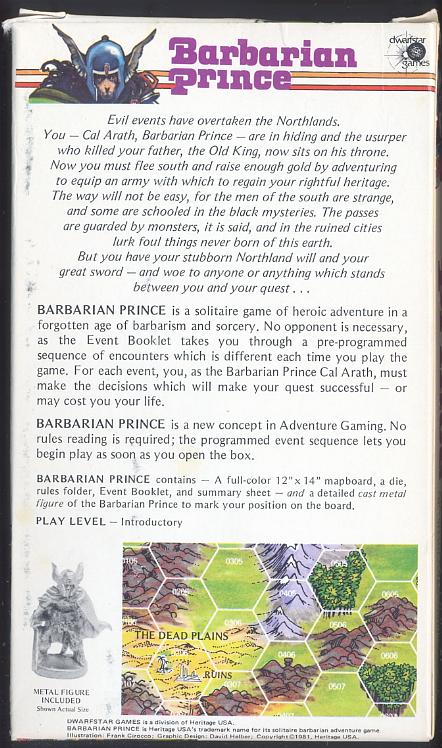
I stumbled across some resources here, http://dwarfstar.brainiac.com/ds_barbarianprince.html and it gave me some ideas of how a hex map like this and events might be fun to add to a homebrew Heroquest for overland adventures and exploration!

I was considering making a collection of separate hex tiles that represented a few different geographic terrain types, and having each player draw them randomly one at a time as they travel into unknown territory to create their own progressively generating overworld map.

Each Hero would move across the terrain tiles, and each geographic area would subtract a different number of movement, something like, Field =1, Forest = 2, Swamp = 3, Mountains = 4. Perhaps there could be decks of cards for each terrain type, and a Hero draws a card when they decide to make camp.

The discovery of secret dungeons or treasures or wandering monsters could play into it as well. Imagine the suspense of traveling and arriving at a dungeon after fighting a band of Orcs in the woods! And then after vanquishing the dungeon, your group encounters a gang of scavenging bandits on the way back to the village who are after your treasure! Towns and villages could be encountered, and each type could offer certain equipment for sale, or other services.

This idea of a seperate "exploration phase" before, and possibly after each Quest, would add some game-lengtheing factors that could complicate the simple game that is Heroquest, but if done well, it might be a cool addition to the game, and offer some fresh air to our dungeon-delving Heroes :D

Re: Inspired by Barbarian Prince (1981)

PostPosted: July 22nd, 2015, 12:36 pm
by Anderas
If you make them yourself, make them square. Hex is not easy to make, and it adds nothing to the gameplay.

I get that you want to work with different movements for terrain types. If you have that level of detail, it is easy to make square fields having more directions than Hex Fields:

If you have as base movement 2 from field to field in the easiest terrain, then you use 3 if you move diagonally from field to field. (+50%). It is quite good as approximation. Plus, you don't have 6 directions like in Hex (and zigzag if you want to go straight), but instead you have 8 directions. And easier map generation. Not to forget. :D


TL;DR:
If you allow diagonal movement with the use of +50% movement points you have a lot easier map design and more directions than hex can offer.


Apart from that, is your source giving away the campaign book? I'd like to try it one evening when my wife turns on women's tv.

Re: Inspired by Barbarian Prince (1981)

PostPosted: July 22nd, 2015, 12:46 pm
by GimmeYerGold
If I had hex map tiles made, i would go through this company: http://www.printplaygames.com/product/d ... d-counters

Pretty sure the maps and everything for Barbarian Prince are free to download in that link.

The full usage rights are outlined here: http://dwarfstar.brainiac.com/ds_distribution.html

Re: Inspired by Barbarian Prince (1981)

PostPosted: July 22nd, 2015, 2:57 pm
by cornixt
You can use squares, but offset them so that they effectively form a hex grid. So much easier to make than hexagons.

Image

Re: Inspired by Barbarian Prince (1981)

PostPosted: July 22nd, 2015, 4:30 pm
by Baylor_OgreBane
It may help you to look at other similar games like the ol' GW mighty empires. you dont need to read the combat rules or anything, but it may give you some new idea's or ways to slove any problems you might encounter.

Re: Inspired by Barbarian Prince (1981)

PostPosted: July 22nd, 2015, 9:07 pm
by whitebeard
Anderas wrote:If you make them yourself, make them square. Hex is not easy to make, and it adds nothing to the gameplay.

… And easier map generation. Not to forget. :D


Interesting comments. I myself don't care for the look of hex grids. If I didn't want squares, I would probably just use a tape and go in any direction.

(1) The ease of map generation comment should be irrelevant. You should make the map then you drop the grid on top of it as a layer. In fact that the same PNG map file can have multiple grids and you just select which one you want visible, then print.

(2) Gimp has a plug-in for hex grids, so they are as easy as pressing a button.

Wouldn't movement rate on this scale be a function of terrain and weather?

Re: Inspired by Barbarian Prince (1981)

PostPosted: July 23rd, 2015, 3:18 am
by Big Bene
whitebeard wrote: If I didn't want squares, I would probably just use a tape and go in any direction.
(1) The ease of map generation comment should be irrelevant. You should make the map then you drop the grid on top of it as a layer. In fact that the same PNG map file can have multiple grids and you just select which one you want visible, then print.
(2) Gimp has a plug-in for hex grids, so they are as easy as pressing a button.

The point is that GimmeYerGold wants to use the tiles for random map generation - the heroes actively explore terra incognita. Diffefrent concept than making the map (beforehand) and then dropping the grid in top of it.
Having said this, I would use square tiles, too, for the reasons Anderas quoted, plus, real maps (including historical ones) actually have a square grid (longitudes and latitudes), so the gamemap will have a more authentic look.
If you go for hex tiles, I wold consider using Settler tiles. They aready have six different terrain types (plus water), which should be sufficient.

Re: Inspired by Barbarian Prince (1981)

PostPosted: July 23rd, 2015, 6:54 am
by Big Bene
You made me thinking about rules for this project.

Some ideas:
- Tiles and way cards are piled upside-down
- Hero minis are placed on the map = the tiles already drawn and layed down.
- If the heroes are on a tile that has at least one empty space left beside it, they may draw a tile and add it to an empty space of their choice.
- They then have to move the minis on that tile (except it is water) and draw an exploration card, using up all remaining movement (exploration takes its time).
- Different terrain types have different movement costs.
- There are streets or ways that are represented by markers (little rods). Following streets decreases movement costs.
- If the heroes explore new terrain and are on a street, a new street segment is added on the new tile. The exploration card includes information if the street just goes on, takes a turn, ends or divides into two or more.
- other information on the exploration card includes encounters and special places such as towns or dungeons. These are not fixed, but use a dice roll. Also, there are differentoptions for different terrain types.
- Heroes may split up and go to different directions if the group agrees that this is possible - it will cause problems when playing quests thereafter.
- Players as a group decide who draws the next tile and card. If the group has split, each subgroub or hero draws a tile and card.
- At the end of the game, the map should be recorded somehow (the easiest way would be to take a photo).

Re: Inspired by Barbarian Prince (1981)

PostPosted: July 23rd, 2015, 6:57 am
by whitebeard
Big Bene wrote:The point is that GimmeYerGold wants to use the tiles for random map generation - the heroes actively explore terra incognita. Diffefrent concept than making the map (beforehand) and then dropping the grid in top of it.


Indeed!

And piecing together terrain like this sounds like a fragile mess… (square or hex). A magnetic board solution would be very cool here.

Re: Inspired by Barbarian Prince (1981)

PostPosted: July 23rd, 2015, 7:02 am
by Big Bene
Ever played Settlers or Carcassone?
It's stabile enough under normal conditions.
Also, I would use this method only in the "exploration phase". After the map (or part of it) is established and won't change further, I would draw it or print it in a fixed form.