Chwat wrote:After watching AshQuest review this thread! it got me thinking ...
I loved the fact it wasn't supported by GW! I was sick of...
For me HQ was a snug little hide away from the outside world of woehammer...
I detect the possibility of some bias. However justified that bias is, beware of confirmation bias.
I'm glad you mentioned the video. After watching Ashquest, I have some observations.
He states "Nobody has the authority to tell anybody else that they're wrong." Why did he say that people who think they have that authority are wrong? It seems he is saying people are wrong. So his statement seems self refuting.
His position seems based on a subjective relativism, where whatever you prefer is the case(i.e. your Heroquest orcs can be Gommorean Guards from Star Wars in your version of Heroquest) While it's true that there is no obligation to conform your gameplay or imagination to the fictional lore or arbitrary game rules of some game developers imagination, there is a point at which your changes mean you are no longer playing Heroquest. If you change the Heroquest rules to the rules of chess on a section of the Heroquest game board, and later replace the board with a chess board, and later change the pieces to chess pieces, and drop the lore, you end up playing chess and not Heroquest. Even if you think of your chess pieces on a chess board with chess rules as Heroquest, thinking something doesn't make it so. So to discover the reality of a situation we need to look at evidence rather than feelings or preferences. But it is OK to be wrong about something as inconsequential as board games. People can peacefully agree to disagree while thinking of each other as wrong about something but still appreciating other things about each other. To say someone is wrong should not be construed as an insult, as everyone is likely wrong about something. We should all embrace the freedom to disagree.
If Ash's point about Star Wars is accepted (that Rogue 1 is not Star Wars canon, even though it is official and produced by the owner of the franchise(I am not disputing his point)), then it would become invalid to use the argument that MB, because of their ownership and rights, has the final say over whether or not HQ is Warhammer. The fact that the new version of Heroquest made changes to remove GW's IP seems to indicate that there are connections that exist in the classic version of Heroquest.
The claim that only the EU expansions have geographical connections to the Old World is wrong. The North American edition of the classic Heroquest instruction booklet makes geographic connections on page 4:

The Border-lands.

World's Edge Mountains, and Athelorn.
3 of the 4 heros originate in well known Warhammer Locations. There is a difference between an adjacency in a passing reference as a joke(in deadpool?), and the origin stories of most of the main characters in a game with relatively little lore. Any differences in spelling could be attributed to linguistic drift, less emphasis on orthography in antiquity, or transcriptional error. The presence of fimir, chaos warriors, chaos magic, etc. is another point to consider; The connections are throughout the game. How many connections in such a minimal lore world would be sufficient to connect it? If plumes were not depicted at some point, that should not be construed as a statement that there were no plumes. It only indicates that they weren't mentioned at that time.
My initial post mentioned in the video was touching on only one facet of the question. In the Warhammer world of GW, Heroquest is explicitly part of the Warhammer world. So for those playing Warhammer, the answer is definitive that HQ has the same game world as Warhammer. I did not really address the perspective from the MB side of things. I am unaware of MB stating explicitly that classic Heroquest is a separate world from Warhammer. Perhaps the lack of clarity is due to indifference or obliviousness of MB over GW placing the Warhammer fingerprints and foothold in the classic HQ(fingerprints which later needed to be scrubbed for the new version)). When trying to be true to the lore, we do not need to adopt anything from Warhammer into HQ which is unmentioned in HQ, but it seems we must adopt HQ into Warhammer if we are recognizing the Warhammer world as a thing. I feel free within the original HQ lore to not consider the gargoyle to be anything more than a regular gargoyle, since the chaos magic from which it is said to be derived on the last page of the NA core quest book is largely undeveloped in HQ. I also feel free to think of HQ fimir as mere cyclops lizard men who associate with orcs. But if we don't care about being true to the lore, then anything goes, and we might be playing chess.
With regard to Advanced Heroquest, the question is not whether or not it's the same game, but rather if it's the same game world. The difference in rules is moot because there are many different games with different rules within the Warhammer world. It is valid to point out the inconsistencies between different editions of WFB, but they could be attributed to the Warhammer World containing a GW multiverse. The fact that different companies were involved with HQ at different capacities raises more questions than answers.
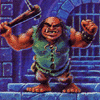
Which world does this art with those characters represent?:
:strip_icc()/pic806419.jpg)
If one side of the story(GW) is definitive, and the other(MB) is vague, and underdeveloped, would it seem more reasonable to side with the definitive established side than to cling to one take of an ambiguous situation?
Personally I prefer underdeveloped HQ lore over GW lore, as it leaves more room for the imagination and leaves out the parts of GW lore that I don't like. But I'm not sure that would be the most reasonable assessment of the situation for an objective answer.





 = one hit
 = one hit & pushback
 = cancels one hit





 HQ is its own world